Sunday, 9 December 2012

The History of the British Open Rally Championship: 1983

British fans had two questions at the start of the 1983 British Open: could anything beat a Quattro in the forests, and could anyone take the title from McRae? The answer to one of these questions was yes and the other no.

There were a few changes to the field for '83.

Mikkola was absent, off to become World Champion. Instead the Quattros were to be driven by Swede Stig Blomqvist and Finn Lasse Lampi. The Stig was a rallying exile. Sweden had got so fed up of Quattros winning all their snow and gravel rallies they'd banned them, so he he'd come over here instead. The clever men in Stuttgart had also been fettling their machines, and the Quattro was no longer such a dog on tarmac.

Opel had been busy too, although problems had delayed the homologation of the Manta 400 and they'd have to start the season with the old Ascona. The new car, when it arrived, promised more power - but less driveability - and a better weight distribution thanks to an engine pushed as far back in the bonnet as it would go.

Vauxhall though were still where they were three years ago, and still using thirteen inch wheels, but at least the old Chevette HSR was reliable.

Once again it was two wheel drive versus four wheel drive. The Ulster had been added to the series, to make six rounds and the extra tarmac would help the two wheel drive cars, but a 'best five' rule would allow the temperamental Quattro a free breakdown, which could even things up.

That was about it for the top line entries, but Group A was now an interesting class. Per Eklund was now in a Group A Corolla 1600GT , and the rear wheel drive car would face opposition from Fords Escort RS1600i driven by Malcolm Wilson and Louise Aitkin. Harold Demuth's Audi 80 Quattro would eventually be homologated into Group A too, but had to start the year as a Group B car. Privateer Chris Lord in the Mazda RX7 would also be contesting this Group.
 
The opening round was once again the Mintex. It started on the Otterburn tarmac and for two stages Russell Brookes's Chevette was the leader in the fog. However once the rally hit the fast Yorkshire forests Blomqvist took the lead in the Quattro. The weather perplexed the organisers, but when the chaos was sorted out Blomqvist won comfortably from Jimmy McRae's Opel, and Eklund was a surprise third ahead of Brookes and Demuth's 80 Quattro.

A Quattro winning on gravel though was not news, however a Quattro leading on tarmac was, and that's what happened on the next round, the Circuit of Ireland. In fact Blomqvist wasn't just leading, he was walking away with the event. Nearest rival was Pentti Airikkala, who was driving by far the most interesting car to appear in the series, at least in my opinion, the Lancia 037 Rally. British fans had seen the car in the previous year's RAC - or at least most of them had, I'd been in bed with a bad cold - but this was its first appearance in Ireland.

The Easter traffic was as bad as ever, and when Blomqvists gearbox broke his service crew were stuck in it and he had to retire. This gave Airikkala the lead in the Italian supercar, but he was finding the mid-engined car tricky to handle. His first encounter with the scenery dropped him him to third, but his second put him out.


The man who inherited the lead was Russell Brookes. Three times winner McRae had had a troubled run, but he still had to hold off Irishman Bertie Fisher in another Ascona before he could claim the win. The Scot's hold on the rally had been broken and it was starting to look like it might be Russell's year.

In Group A Eklund and Wilson retired and Chris Lord managed to hold off Louise Aitkin to claim the win.

The Welsh was next, and finally Opel had the Manta 400. in due course this would become one of the best rear wheel drive rally cars ever, but on debut it understeered terribly and McRae struggled, eventually only managing sixth. This left Brookes to take on the Audis. he beat Lampi, but Blomqvist had disappeared into the distance and won by nearly eight minutes.

In Group A Eklund and Wilson battled it out, with the Toyota a comfortable winner.

The action then moved north of the border for the Scottish which, rather than being hot and dusty, was cold and wet in '83. Blomqvist cruised to an easy win, but behind him Brookes and McRae tussled for the runner up spot. The Manta was starting to work properly now and in the end it all came down to punctures. The Chevette and the Manta both punctured on stage 28. Brookes had to stop and change the wheel whilst the Opel was able to struggle to the end of the stage, which gave the Scot second.

Eklund, meanwhile, won Group A by twenty minutes as the opposition fell apart.

It was back to the black stuff again for the Ulster Rally, but any hope that this would allow the two wheel drive cars to head Blomqvist were soon dashed. The Swede was again unbeatable. McRae had a troubled rally with the Manta. At one point the heater caught fire, and on another stage he had to stop to let petrol fumes out of the car. He must have wished for his old Ascona back.

Brookes's Chevette was running fine though, although the driver had 'flu. He spun on stage 5 but only lost thirty seconds, and was hanging on in third, unable to match the pace of Irishman Bertie Fisher in his Manta. Blomqvist had transmission problems, which briefly put Fisher in the lead. Brookes's co-driver Mike Broad put in a complaint that Audi had serviced the car illegally, but it was rejected. Instead Blomqvist soon regained the lost time won the rally by over a minute.

This left Blomqvist on 60 points to 53 for Brookes. Due to the 'best five' rule, to be champion, Brookes had to win the last round outright and Blomqvist not score at all. So it was all to play for on the Rothmans Manx.

As Rothmans also sponsored the series and the Opel team, they sent along a brigade strength squad for the event, consisting of Ari Vatanen, Henri Toivonen and Jimmy McRae. These three were soon leading, with the young Finn just ahead of his older countryman. Brookes was fourth until a puncture on day two cost him two and a half minutes, and dropped him to seventh, just behind Blomqvist.

McRae ended an unhappy year when the Manta's axle gave out, elevating everyone a place. The Audi engineers then turned the Quattro's boost up to eleven and Blomqvist started moving up the field with Brookes right behind. The Quattro was third behind the Opel pair, when it started stage 44 out of 49. Brookes was following and could see the Audi across Druidale when "Suddenly there was a mushroom cloud of oil smoke - it was like an atomic explosion." With a piston sticking out of the side of the engine block Blomqvists championship was over.

There was now the possibility of GM giving the Opels team orders to let the Chevette past. Brookes had asked before the rally what would happen in this situation, but he denied actually asking for the Mantas to be slowed. "I would not have wanted to win the rally that way," he said in 1983, although he'd clearly changed his view by 1989......

Eklund won Group A from Lord's RX7. He'd wrapped up  the championship in Ulster but his seventh overall put him fourth in the overall championsip. This was a nice result for the Swede after two years of driving unreliable and slow Celicas.

Russell Brookes though was disappointed to be runner up. He had scored in every round and said "I have driven harder, faster and better in 1983 than I have ever driven before." He had beaten McRea for the first time since the Scot had moved up to driving top level cars. After two disastrous years with Talbot and a troubled debut with Vauxhall, he was now back at the front of the field and would challenge for the title in every year for the rest of the decade.

But for Vauxhall Chevette this was the end, at least as a Works car. Conceived, rather optimistically, to win the 1976 RAC Rally, the Chevette had indeed been a 'better Escort' but had now run out of development. Airikkala had driven one to win the 1979 Open, but every other year had been a disappointment. We fans, though, loved the tail-out Chevette and its disappearance from rallying was another nail in the coffin of the ailing British car industry.

So it was a Swede who was British Open Champion. Not that we minded too much. We knew Stig, you see, and had been following his exploits since he'd won a particularly snowy RAC Rally in 1972. Besides, Stig could make the Quattro dance, he was the only one who could. Years of chucking overweight Saabs around the forests and rallycross tracks had given him car control second to none and for the first time we could see an Audi sideways.

He was far and away the quickest Quattro driver of them all, and Audi were starting to realise this as well. Two months after his engine blew in the Isle of Man he won the RAC Rally, and for the next year Audi gave him a shot at the world title. He took the opportunity and ran with it, and became the 1984 World Rally Champion. Like Vatanen three years before, the Open had been the springboard to the top of the tree.

This just showed what an important series the British Open was.

Blomqvist 60 points
Brookes 57 points
McRae 47 points
Eklund 34 points

Saturday, 8 December 2012

The History of the British Open Rally Championship: 1982

Fire up the Quattro, it's time for action.

1981 had been fun, but it had all been a bit insular and provincial. True, the World Champion that was (Walter Rohrl) and the World Champion to be (Ari Vatanen) had both popped by, and there were a couple of Belgians on the Manx, but all the drivers battling for the series had been British resident even if, like Pentti Airikkala, they weren't British born.

However for 1982 that all changed. The world and his wife came to battle it out on the Open. The last round of the series, the Manx, featured seven A Priority Drivers, that is, drivers who have won a World Rally or the European Rally Championship in the last three years or finished in the top three of a WRC round, or the top five of the ECR, in the last twelve months. Jimmy McRae was British but the other six, Ari Vatanen, Hannu Mikkola, Guy Frequelin, Henri Toivonen, Stig Blomqvist and Per Eklund, weren't. One was the World Champion, two of the others were future champions, one was a future multiple European rallycross champion  and another was die whilst the fastest rally driver in the world. It was a stellar cast.

But we are getting ahead of ourselves. The series started, as usual, in a chilly Yorkshire with the Mintex, and leading the field away from York was Mikkola in the Beast from Stuttgart, run by our own David Sutton. Vorsprung durch Masses-of-Grunt-and-Grip, the Quattro was like something from a different planet in 1982.

However in these days of bang-bang devices and clever differentials it's hard to explain just how dull four wheel drive and turbo charging was when it first arrived on the rally scene. The Quattro was quiet, and it braked and accelerated in a straight line.  Apart from the speed at which it could accelerate out of a slow corner, it did not look like a rally winner.

Looking more like the real thing was reigning champion Jimmy McRae, still in an Opel Ascona 400 but now part of the Rothmans team, along with 1980 RAC winner Henri Toivonen. Russell Brookes was still sponsored by Andrews Heat for Hire, but had ditched the unlucky Sunbeam Lotus for a Chevette HSR. Vatanen was in a black MCD Escort and Per Eklund was getting ready to have another go at making the Toyota Celica competitive. The man left standing when the music stopped was 1979 Open Champion Pentti Airikkala. With no works drive, he bought himself an Escort to compete.

On the opening round though, it was the Quattro that was the car to have, and Mikkola led from the off and started taking ten seconds a stage off everyone else. Behind him the others were struggling for grip. The Finns though seemed to be having the better of it. Vatanen and Airikkala battled it out through Yorkshire, with Pentti getting his private Escort ahead of the David Sutton machine only for steering failure to end an inspired drive. Toivonen took over the chase and closed the gap when Vatanen's engine went off song in Dalby forest.  Seconds separated the Finns as they went into the final sprint around Oliver's Mount, but on the Scarborough tarmac Toivonen's Opel was quicker and he snatched second place.

Leader of the home drivers for most of the rally is National Champion Terry Kaby. McRae has a slow start but gradually rose up the field to finish fourth. It had been a poor showing for the home team though and the Scandinavians had totally outclassed them.

Fortunately the next round was rather better suited to home grown talent and two wheel drive machinery. The Circuit of Ireland was five days of blind tarmac rallying round Ireland. There is nothing like it today. The Rothmans Asconas shot into the lead, but Mikkola was floundering in the big Audi. They weren't totally invincible it seemed.


McRae led, then Toivonen, then McRae again. Then Toivonen left the road and climbed a bank. Damage to the car was minimal but he's broken a bone in his wrist. Carrying on would be painful, but carry on he did. Vatanen then took up the chase, the World Champion pedalling the Escort as hard as he could, but not making much progress against McRae. Mikkola's Quattro was snapping driveshafts and David Sutton was reduced to pouring Coca Cola and then flour into the gearbox to prevent clutch slip. Brookes had been delayed early on by electrical problems but was now charging up the field.

Vatanen looked like he might just steal a win until he took a yump too fast and damaged the Escort, dropping him right down. Brookes had fought his way up to second, but a brave Toivonen held on for third but Mikkola was down in sixth, behind a pair of Irishmen. It was Jimmy McRae though who won, making it a hat trick of Irish wins for him.

For the Welsh though Mikkola was absent as Audi had sent him to the Tour de Corse, a decision they probably regretted as Mikkola's steering failed before the first stage. The real world also threatened to interrupt the rally, as it was feared that the army would want the Epynt ranges, which made up half of the rally, to train for the Falklands War.

In the end the rally went ahead without trouble, Walter Rohrl had said an "educated monkey" could win in a Quattro, but in the end Audi chose a different sort of primate for the event, the 1979 World Champion, and 1977 RAC Rally winner, Bjorn Waldegard. He vaguely remembered Epynt from an RAC a few years back, and was soon proving that Quattros could go well on tarmac. The Swede, who in his time had rallied everything from a Lancia Stratos to a Mercedes 450SLC, led from the off and took a comfortable victory.

Behind him there was chaos. Vatanen took a wrong turn on Epynt and was excluded whilst on the last blast through the tarmac McRae tool a "95mph corner at 100" and totalled the Ascona. Team mate Toivonen took second and the series lead whilst Stig Blomqvist, in a Talbot Sunbeam Lotus, was third.

It was back to the forests again for the Scottish Rally, and with Mikkola returning another Audi walkover was expected. But that wasn't what happened.

Instead the Quattro broke its steering arm - again - on the first corner of the first stage. Mikkola managed to get the car off the stage in reverse, but he'd lost nearly eight minutes and was dead last. Vatanen was leading, chased by Blomqvist and the two Rothmans Asconas, but Mikkola was after them. The Quattro overtook Malcolm Wilson to lie fifth by half time at Aviemore.

As they raced through the northern forests Vatanen retired with a broken driveshaft handing the lead to Blomqvist, who then retired with head gasket failure. Mikkola overhauled Russell Brookes, then Toivonen and then finally leader McRae. He won in the end by a massive ten minutes, but he'd done it the hard way.

So it was all to play for on the Manx, three days of pace noted tarmac stages with an A list cast. McRae needed to win the rally to retain his Open title, with Toivonen, Mikkola and Brookes all in with a chance if he didn't.

On the first day though, it is the Finns Vatanen and Toivonen who were dicing for the lead whilst Terry Kaby led the home challenge. Mikkola was again struggling and didn't make the finish, and both Talbots expired with engine trouble on the same stage.

Toivonen lost the lead when he punctured, but regained it when Vatanen crashed after a yump. Toivonen then has electrical problems, allowing McRae into the lead. With the car fixed he took off in pursuit of his team mate, only to crash out of the rally. This left McRae with a comfortable lead over Brookes, which he held to the end.

So it was the part time heating and plumbing engineer from Lanarkshire who was champion. The best drivers in the world had come to the British Isles to try to take the title off him, but had failed. The Scot had had a good year, also winning rallies in Belgium and Ireland and coming second in the European Rally Championship.

But whilst a Brit may have won the Drivers award, every round had been won by a German car, With a series that featured two tarmac, two mostly gravel and one 50/50 rally, the battle between two wheel drive and four wheel drive had been fascinating. Had Mikkola skipped Corsica and gone to Wales he may have won both the rally and the championship, but that wouldn't have stopped Opel taking the manufacturers prize. The Ascona 400 had shown it was the perfect car for the series; a reliable all rounder. The Quattro had proved unbeatable on gravel, but too complicated and unreliable for a series where every score counts.

Audi would be back though, and next time the British boys wouldn't find it so easy.

Thursday, 6 December 2012

The History of the British Open Rally Championship: 1981

1981 and Sedan Products bow out as the event sponsors, handing over to the glitzy Rothmans outfit. Nobody at the time was too bothered about the ethics of taking cash from a company selling addictive drugs that cause cancer - well, it was Thatcher's Britain - but they were worried about overkill as Rothmans now sponsored the series, one of the rounds and one of the leading teams.

This was also the last year in which everyone - except the army guys in their Land Rovers who tagged onto the end of the Welsh rally - was in two wheel drive cars. Abroad the new Audi was setting the stages alight, but back home Ford, Opel, Toyota, Talbot and Vauxhall battled it out in one last glorious year of high revving, multi-valve engines and tail-out opposite lock before the whispering Quattro spoilt the fun of forest rallying.

Escort development had come to an end two years ago, but the others were still trying to make a 'better Escort'. Opel and Vauxhall could make some claim to have managed to build one. The GM teams had amalgamated and their very different cars both seemed more stable in fast corners than the old Ford. 

With reigning champion Vatanen largely absent as he pursued glory on the world stage, the drivers were mostly UK based, except for Per Eklund in the Toyota Celica. Airikkala was back, driving a Rothmans Escort for David Sutton. Jimmy McRae had left Dealer Team Vauxhall to drive the new Ascona 400 for Opel and in the Chevett was now Tony Pond. Brookes was still in the Sunbeam Lotus, still down on power and still waiting for the promised international drives. 

The opening round was the Mintex again and just like last year there was ice and snow and just like last year it was a Rothmans Escort out in front, although this time it was Airikkala. Last time we'd seen him in a Ford he'd been leading the 1976 RAC rally, and he carried on where he left off.

The initial blast through the Otterburn army ranges saw Tony Pond fit slick tires only to find ice instead of  tarmac. He left the road and went OTL. Everyone else lost time due to the ice and all but one of the stages ended up being cancelled, but Pond was still out. McRae then chased Airikkala's Escort as hard as he could, but the Finn easily held off the Scott for victory.

The Circuit of Ireland was next and Pond was once again on slicks but this time finding grip. He flew into the lead and was leaving the field behind when the Vauxhall drive system let go. He handed in his time card, but then the stage was cancelled. It wasn't turning out to be Pond's lucky year.

McRae inherited the lead, chased by Brookes. However a tightening right hander caught out the Englishman and he thumped a bank. Ever the pro, he made sure it was the co-driver's door which was stoved in and Mike Broad who received the bruised arm. They kept going, but too far back to challenge for victory and McRae took the laurels.

For the Welsh Rally the big news was that Vatanen was back, and soon leading, chased by Pond. He punctured and dropped behind Pond and Brookes, then Pond disappeared up a fire break whilst flat in fifth and lost enough time to give Brookes the lead, a very unfamiliar position for the Andrews Heat for Hire Sunbeam.

It didn't last though, and when an oil pipe let go Vatanen got the lead back again. McRae pulled back time on the Epynt tarmac and he just nosed ahead of the Finn before it was his turn for a puncture. Vatanen then took the lead for the third and final time whilst Pond put on late spurt and also passed McRae to take second whilst Airikkala was fourth.

In the Scottish Rally Pond was again quickest off the mark, leading Airikkala through the forests, the rest of the field in hot pursuit. Both Rothmans Escorts went off on the same stage and the Brookes' Sunbeam was sick for most of the rally, but on home soil McRae gave the Chevette a run for its money. Pond has his measure though and came home a minute clear of the Ascona. Airikkala was fourth behind team mate Malcolm Wilson. The Escort pair had extracted their cars from the trees but Penti's was handling like a dog for the rest of the rally.

McRae then entered the last round with a comfortable lead in the championship. Only Airikkala could beat him, and only by winning outright.

This was the Manx, now well on the way to becoming a true international rally thanks to Rothman's cash. Star entry, and early leader of the Manx, was reigning World Champion Walter Rohrl, driving a private Porsche since Mercedes had cancelled their rally program. A grinning Rohrl admitted to driving "too quickly" and getting the Porsche up to 135mph and frequently airborne, but he still could not shake off McRae and Pond. Airikkala crashed out, leaving the Scotsman with a smug grin. The championship was his, but he wanted the rally as well.

Pond had survived a 100mph spin and when night fell he and McRae found they had the edge over the German in the dark and both Brits overtook the German. Rohrl fought back once the sun rose again but couldn't catch up. The Scott told the cameras he was driving for European Championship points, but Pond didn't believe him and the stage times suggested otherwise as well. However, the Englishman held on and won. Rohrl suffered a broken drive shalf on the last stage, so Wilson came third, but his Escort had been totally outclassed by the GM boys.

Pond had been the fastest man in the series and it seemed unfair that he was not to be champion this or any other year.  A great driver, especially on tarmac, and a ready wit, he was signed up by Datsun and then Rover for International events, but was never given a competitive car. He eventually left rallying to concentrate on circuit racing and cameo appearances, like doing a 100mph lap of the TT motorcycle circuit in a Rover 700 Vitesse. He died, far too soon, in 2002.

Instead it was McRae, who finished on the podium in every event, who took the title, which must have made his thirteen year old son Colin very proud. Ari, now Private Vatanen of the Finnish Army, can't have minded either as two months later he became World Champion on the RAC Rally.

But Vatanen didn't win the RAC, he only came second. The winner was Hannu Mikkola in the first British appearance of the Audi Quattro. British rallying was never to be the same again.

Jimmy McRae 53 points
Tony Pond 40 points
Pentti Airikkala 29 points
Malcolm Wilson 27 points
Russell Brookes 17 points

Sunday, 2 December 2012

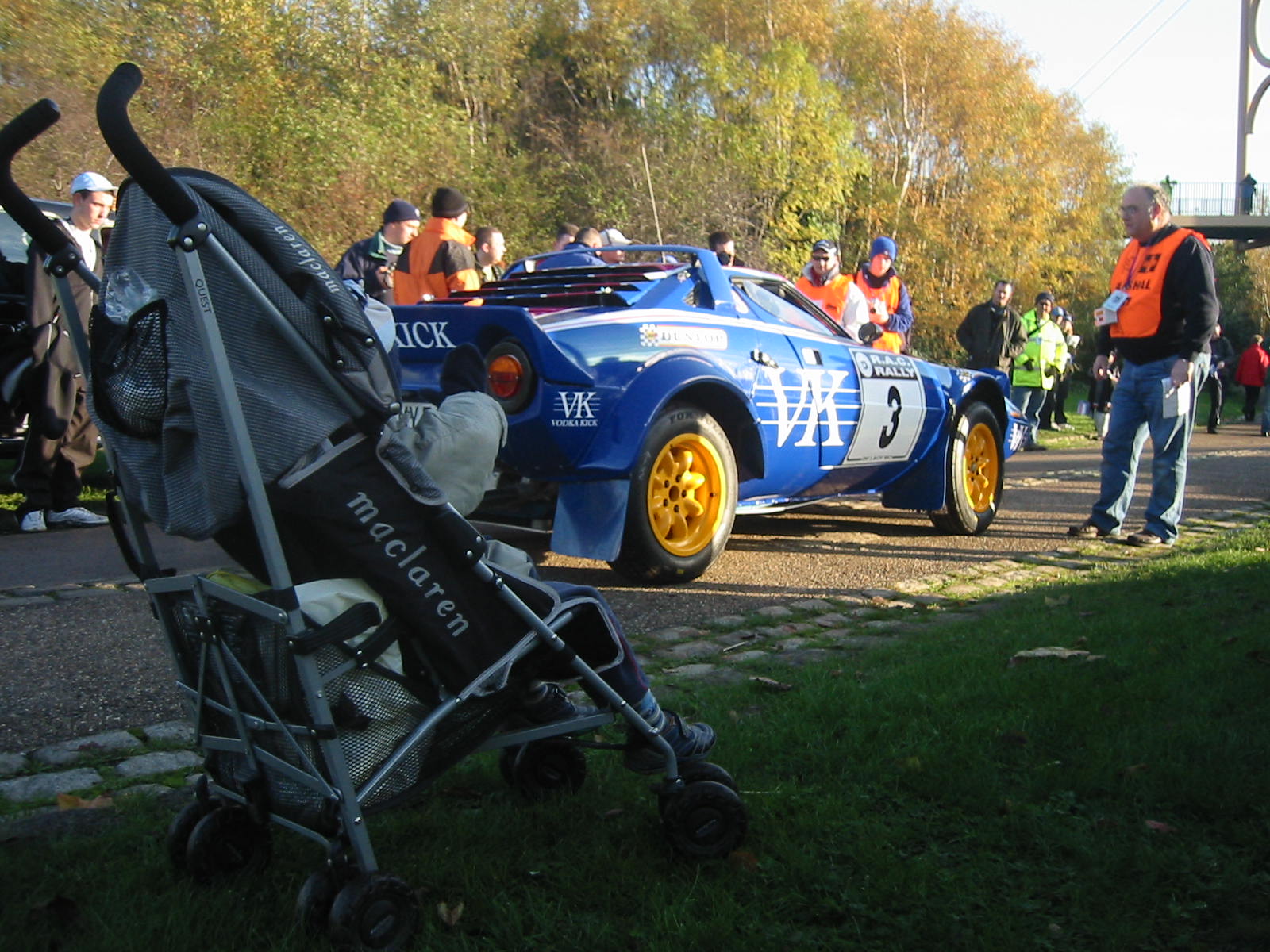
Stratos versus the RAC

The Lancia Stratos so dominated the World Rally Championship in the mid seventies that it's more interesting to discuss the rallies it didn't win than those it did.

A series of disasters afflicted their three expeditions to the Safari, the rough roads of Greece took their toll year after year and they never bothered to send such a nervous car to the smooth, fast roads of Finland. However the rally that the Stratos really should have won is our own RAC rally.

Fords dominated the event, but I wasn't the only spectator shivering by the side of the stage waiting for the Boreham boxes to pass so we could see - and hear - the exotic Italian supercar. If the Stratos looked out of place in the middle of Africa, it seemed no more at home in a cold, and frequently wet, British forest.

This was a rally the car really should have won at least once. Here's the story of how they failed.

1974

The Stratos was homologated in 1 October 1974 and by the time of the RAC Rally had already won two World Rallies. Sandro Munari brought the car to Britain and with his regular co-driver ill and himself suffering from food poisoning he was content to settle for third behind Timo Makinen's Ford Escort RS1600 and Stig Blomqvists Saab 96 V4.

However he's scored several fastest times on the way and had shown the car's potential. British fans took note.

Autosport journalist Peter Newton wrote of the experience "A deep musical throb among the distant trees, then with a bark of triumph, the Stratos leaps out of the gloom into the sunlight, its driver corrects and the red-and-white projectile hurls itself at the straining watchers on the corner. The sheer speed of its arrival takes everyone by surprise.."

1975

Before....
Lancia now realised they had a car that could take on the world, but expecting Munari to do all the driving was asking a bit too much of him, so they recruited Swedish ace Bjorn Waldegard to help out. Waldegard had made his name in Porsches and was expected to win the tricky northern European rounds, leaving Munari to take the glory on the other events.

Well, that was the plan anyway.

On the 1975 RAC Waldegard was flying in the new Alitalia liveried car. Literally. After 16 stages he had set 6 fastest times and was comfortably in the lead. He then flew too high on a yump in Pickering and broke a drive shaft. Mechanics changed it on the stage (that was legal then) but at a cost of one hour of delay and all of his rear bodywork.

.... and after.
Waldegard continued in the event and continued to set fastest times, but he'd been OTL and was also running without brake lights, rear lights and a rear number plate.

Exclusion was the result and with Munari crashing out it was Lancia nil points.

1976

He should have got his revenge the next year, but it all went wrong in San Remo.

Waldegard had ended the penultimate stage four seconds ahead of Munari. As it wouldn't do for the top Italian rally driver to be beaten on home soil Waldegard was instructed to let his team mate win. Waldegard came to the start of the last stage and was waved away. The car didn't move for four seconds. With everything square he then blasted off at full speed to win the stage, by four seconds.

Lancia were not impressed and sacked him on the spot. Ford signed him immediately and started cobbling a car together for the RAC.

Munari was again the lone Lancia on the rally. He set a few fastest times - including at the New Brighton spectator stage where little me was undergoing my RAC baptism - but mostly he appeared to not want to be there. Indeed the entire team appeared to have a case of the blues.

He eventually finished fourth, just behind Waldegard, who was busy telling the press he'd have won the event in a Stratos.

A second car, run by the British Chequered Flag team and driven by Per Inge Walfridsson  struggled before retiring with electric problems in Yorkshire.

Shortly afterwards the world found out what had caused the long faces in the Lancia camp. Fiat group headquarters had decided that next year the Fiat team in their 131 Abarths was to be given priority in World Championship.

1977

Turin only allowed Lancia to enter four World rounds in '77, but fortunately for us, one was the RAC.

Munari was again the only Stratos man, and again he struggled with the conditions and the secret stages.

At the end of the first day he was fourth, at the end of the second he was fifth and by half way he was ninth. The Stratos's gearbox then jammed in gear, loosing him an hour, but he carried on for the fans and eventually managed 25th, setting a fastest time on the last stage.

1978

This was to be the Stratos's last year as an official rally car, although once again Fiat were given priority in the WRC. Former Fiat man Markku Alen had switched to a Stratos for the San Remo rally, swapping cars with Walter Rohrl who had been campaigning it in Germany. He'd won the rally after the German launched his Fiat off a cliff.

Alen thought the car would be more suitable than the 131 for the RAC and so he and Munari entered their red, white and black Pirelli cars for what was supposed to be the last official outing for a works Stratos.

The press made the most of the occasion and Lancia managed some secret tire testing at Donnington whilst giving motoring journalists a ride in the car.

Thanks perhaps to this Alen stormed into a lead over the Sunday 'Mickey Mouse' stages and prepared for 'Maximum Attack' in the forests. However he was now entering Escort country.

The RS1800 had grown into the RS, with 15 inch wheels and various other tweaks. The Stratos meanwhile was going backwards, with its 24 valve engine banned.

Through Yorkshire Mikkola and Alen swapped fastest times, then in Kielder Mikkola turned it up to eleven. He beat Alen by thirty seconds in Hamsterly to take the lead and then took two minutes off the Stratos in next two stages.

Alen hung on grimly for a while, but was last seen by the side of the road in Twiglees with the back open. An Italian mechanic, asked to explain, just gave some exaggerated hand gestures and said "Mayonnaise..." The official reason was given as gearbox failure. With Munari parked up with electrical problems, that was that.

1979

Or that should have been that.

However next year Alen was back with another Stratos. Lancia had found an old car for him and it had been prepared by a private garage. For a while there was a second Stratos on the entry list, for Bernard Darniche, who'd won two rallies that year and retired whilst leading two more, but in the end the Frenchman was a no-show in Chester.

Once again Alen led over the Sunday stages, and once again he was overtaken in the forests. He pulled a bit of time back later in the rally in the fog, but eventually could only manage fifth.

1981

In 1981 British fans got their first sight of the Audi Quattro and the little Renault 5 Turbo. But for me there was only one car to see, Markku Alen driving another museum piece Stratos. And I finally got his autograph.

Unfortunately he was never on the pace and eventually put the car into a ditch in the Scottish borders.

That really was that.

2005 - 2012

The RAC itself turned into the Network Q and then got itself stuck in south Wales, eventually becoming the Wales Rally GB.

However there were still people who remembered what it used to be like, and so in 2004 the De Lacy motorclub launched the Roger Albert Clark rally for historic two wheel drive rally cars.

In 2005 alco-pop king and former British Rally Champion Steve Perez entered a Lancia, and it was time for the next generation of little Porters to see a Stratos in action.

His classic car was never able to keep up with latest Escorts, some of which have some very un-seventies mods, but he was the fans favourite. There is still nothing like the sound of an Italian V6 coming through the dark, and no rally car before or since - including the Ford RS200 - has ever matched its lines.

It may never have won an RAC, but for British rally fans, the Stratos is still a very special car.

Wednesday, 28 November 2012

Nearly Great Rally Cars: The One Hit Wonders

Some rally cars dominate the stages and go down in the history books; the Lancia Stratos, Ford Escort RS, Audi Quattro, Peugeot 205T16, Lancia Delta Intregale and Citroen Xsara WRC all won shed load of rallies and have their place in history.

Other cars fared less well.

However to even win a single World Rally is an impressive feat. The Mini Cooper S, Opel Manta 400, Ford RS200 and Sierra Sapphire Cosworth didn't even manage that. These cars then, that only graced the top of the podium once, are not to be sniffed at.

To keep the list manageable I'm going to disqualify variants of the same model of car, with the exception of a certain Saab. I'm also not counting the 1995 Toyota GT-4 ST205 as the reason it is only credited with a single win is that the team were caught cheating and disqualified from the championship, leaving even it's single victory tainted. That still leaves a pretty long list.

Interestingly only one entry is from the last twenty years. No longer do minor manufacturers enter their less competitive cars in less popular rallies in the hope of sneaking a surprise win, and no longer can less conventional cars hope to triumph in unusual conditions. Sadly the sport is less of a spectacle as a result.

Datsun 240Z Safari 1973

The 240Z really is a great rally car, although it was antiquated even when it was new. Like the old Austin-Healey 3000 it was a powerful engine bolted to a rock solid chassis.

Never quite on the pace in Europe, on the rough tracks of Africa the driver could unleash the power and watch other cars fall apart trying to keep up.  On the Safari in 1974 Datsun not only won with the 240Z, but took half of the top six places.


BMW 2002tii Austrian Alpine 1973

The 2002tii certainly counts as an almost great rally car. Not quite as good as an Escort RS1600 or a 124 Abarth, and from a manufacturer more committed to roundy roundy stuff, it could never-the-less cut it with the others in the right conditions.

Future World Champion Bjorn Waldegard cut his WRC teeth in one, but it was Archim Warmbold who pedalled it to its only victory, with Bernard Darniche in the world conquering Alpine A110 a distant second, in the only running of the world’s oldest rally in the WRC.

Renault 17 Gordini Press On Regardless 1974

Two cars dominated the early years of the WRC; the Renault Alpine A110 and the Lancia Stratos. However both manufacturers knew that the number of drivers who would buy their exotic machines to commute to work in was extremely limited. 

As a result both produced tamer road cars in an attempt to cash in on their rallying success. Lancia’s was the Beta, a disaster of a car that usually went rusty before it had left the showroom. Renault, meanwhile, produced the 17 Gordini. 

A sort of Gallic Ford Capri, it had a certain butch charm. And whilst it was unlikely to beat a well driven Stratos or A110, thanks to Renault raiding the Alpine parts bin it was capable of a reasonable turn of speed. 

On the 1974 American event, with a series of disasters wiping out the official Fiat team, French ace Jean Luc Therier was able to bring his car home ahead of Markku Alen’s surviving 124 Abarth.

Opel Ascona Acropolis 1975

The car may be unfamiliar, but the driver isn’t. Walter Rohrl took his first WRC victory in this car, a Panzer of a machine whose main virtue, according to Herr Rohrl, was that you could drive it off a small cliff with no ill effects.

The Acropolis was probably the only European rally it could ever have won. The Stratoses were faster, but both left the road and then broke leaving Rohrl to fight off local hero ‘Sirocco’ in an Alpine. Opel and Rohrl would combine again and become World Champions, but this is where it all began.

Datsun Violet 710 Acropolis 1976

The next year Lancia again started the Acropolis as favourites, and once again all three expired. Again the winning car was more renowned for strength than speed and once again ‘Sirocco’ came second.

There isn't a lot to say about this Datsun. They were campaigned in this country and elsewhere to limited effect, although fans liked the distinctive sound of the twin cam engine.

Saab 99EMS Swedish 1977

Saab started the 70s with one of the great rally cars of all time in the form of the 96. However by the middle of the decade it was clear they were loosing out in the power battle. The 99 evened things up, but with that extra grunt came extra weight.

Saab were swimming against the tide in two respects; persisting with front wheel drive – then very unfashionable – and refusing to produce a ‘homologation special’.

The 99 was therefore a car that took special conditions to win, and the Swedish rally provided that. Traction, and local knowledge, beat power and Stig Blomqvist was able to left foot brake to victory ahead of two more convention Opels. He had had a massive dice with the two works Fiat 131 Abarth, but when Makinen’s shed a rotor arm and Alen’s decided to provide some much needed warmth by bursting into flames, Blomqvist cruised home.

He would go on to be World Champion, but the normally aspirated 99 never troubled the podiums again.

Saab 99 Turbo Swedish 1979

Realising they were going nowhere with the car, Saab decided to try the appliance of science and become the first team to seriously campaign a turbo charged car.

The machine had shown promise on the 1978 RAC, impressing a very young me as well as more experienced pundits, but it took the rather special conditions of the Swedish again to gain victory. The Escorts were faster, but Mikkola and Waldegard both left the road and Vatanen succumbed to the old BDA Achilles Heel of head gasket failure.

However it had been a historic win, with Fiat and Vauxhall both beaten fair and square. The first victory for a turbo charged car, but, alas, the last for Saab. They never did get the Turbo properly sorted and Blomqvist reckons the best 99 they ever made was the normally aspirated Group A version in the 1990s.

Toyota Celica 2000 GT New Zealand 1982

The Toyota Celica must be one of the unluckiest rally cars ever.

Team Toyota Europe won a brace of World Rallies with the 1600cc Corolla and had high hopes of adding to the tally with their new 2 litre car. Unfortunately with Ford and Fiat engaged in a battle royal for the title the car didn't get much of a look in, with second on the 1977 RAC being its best result. Worse, they then lost half their valves in a rule change and by the time they got them back the world had moved on.

They tried a new holologation of a new body style and, in the era of the Audi Quattro, didn't hold out much hope.

Then, in New Zealand, it all went right. The Quattros failed and Walter Rohrl in his Opel Ascona 400 drove for a finish on a blind rally he doesn't enjoy. Toyota had not only won, but scored an impressive one-two with Waldegard leading home fellow Swede Per Eklund.

Having finally found its winning ways, the Celica didn't look back. The next version was the Africa-conquering Turbo and that was followed by a series of world class four wheel drive models before the final disgrace in 1995 and a return to the Corolla.

Audi 200 Quattro Safari 1987

When the FIA banned Group B cars at the end of 1986, every team except Lancia was left in the lurch. The Italians had a nice little compact, turbo charged, four wheel drive car in the Delta Turbo. Everyone else though was short in at least one area.

Mazda had a good, small four wheel drive, but it only had 1600cc. Ford had a great engine in the Sierra Cosworth, but it was only two wheel drive. Audi, meanwhile, had a good engine and a proven all wheel drive system, but the only homologated car to have them was the palatial 200 Quattro.

In Europe the car was far too big, but in the open spaces of Africa that didn't matter. Hannu Mikkila diced with his old rival and former team mate Waldegarde across Kenya, but the Swede's Toyota Supra wasn't up to the job and Mikkola led Rohrl home for an Audi 1-2.

Six years early Mikkola and Audi had ushered in the four wheel drive revolution by knocking six minutes off their nearest rivals on the first six stages of the Monte Carlo Rally. Since then they'd won seven World Rallies together, but this was to be their eighth and last. The end of an era.

BMW M3 Corsica 1987

The M3s maiden win in Corsica that year was also the end of an era; the last time a front engined, rear drive, normally aspirated car won a world rally.

Tarmac makes up a significant proportion of the WRC today, but back in 1987 the Tour de Corse was the only all asphalt event and so one of the few rounds anyone had a chance of beating the all conquering Lancia Delta Turbos.

Ford had a series of mishaps, Ragnotti put his Renault 11 Turbo off the road and so it was up to David Richard's private Prodrive outfit to take on the might of Turin.

The M3 handled brilliantly and had been unbeatable in its class on the circuits, but making it a rally winner was still an great achievement for the Banbury team.

Driver Bernard Beguin had just missed out becoming European Champion in 1980 and had really had a career in which he failed to achieve his full potential, until this rally. The Lancias didn't give up without a fight, with fellow Frenchman Yves Loubet being the fastest. He took the lead when the rain came, but lost it when he had tire trouble, allowing Beguin and the M3 to take their maiden victories.

Ford Sierra RS Cosworth Corsica 1988

The first rallying Ford Cosworth was a great car in every way except its lack of four wheel drive. Like the M3, Corsica was the only place it could win. In '87 the Fords had failed, but the next year they returned with cars specially prepared for tarmac, including flame spitting side exhausts.

This time it was the BMWs which broke, leaving the blue oval to fight the might of Lancia, again led by a flying Loubet. The Lancia Delta Integrale was the quicker car, but Loubet lost eight minutes when his gearbox stuck in neutral and so it was a young Didier Auriel who gave Ford their first win in the WRC since Vatanen's Escort RS in 1981.

This too was a historic moment; the last time a rear wheel drive car won a world rally. BMW would try again next year with the fastest M3 Prodrive had ever built, but by then the Integrale's were too good. It wasn't quite the end of two wheel drive. In the late nineties the lighter weight of the Formula Two Kit Cars would give the Citroen Xsara a couple of victories, but there would be no more wins for tail out rear drive cars. A real pity.

Opel Kadett GSi New Zealand 1988

With all wheel drive and a turbo required to win rallies, the WCR effectively split into the teams going for glory, which in 1988 was just Lancia and Toyota, and those battling for class wins with hot hatches.

There was lot of pub talk at the time about which was the best hot hatch, with the VW Golf GTi and Peugeot 205 GTi having their fans amongst beer drinkers - with the XR3i being popular for those on Australian lager - but on the stages the clear winner was the Vauxhall Astra GSi.
Rallied abroad as the Opel Kadett, it picked up regular class wins but didn't have any chance of a top placing unless the Lancia and Toyota teams stayed home. However with the Italians having wrapping up the WCR in June with a win in America, that's what happened in New Zealand.

Pretty much nobody you'd heard of entered the rally - except Jimmy McRae, and he retired on the first stage - and the winner was an unknown Austrian called Josef Haider. Opel had been rallying for more than twenty years by this point and had managed to make Walter Rohrl World Champion along the way, but this was their last win on the WRC.

Nissan 200SX Ivory Coast 1988

Nissan were another team left with vitually nothing to rally when rule changes outlawed their growling 240RS.

Instead they opted to make their middle-of-the-road coupe an Africa beater and, although it took a while, they got there in the end.

The rally was poorly attended, but French Africa expert Alain Ambrosino had a hard fought duel with Austrian Rudi Stohl in an Audi Coupe. It ended when Stohl crashed in the Tai Forest and broke his arm, which is not something you want to do when you're half a day's journey away from a hospital.


Renault 5 GT Turbo Ivory Coast 1989

By this time it was clear the Ivory Coast rally's days were numbered. The works teams stayed away, leaving only a motley assortment of privateers to battle it out. That's how a tiny Group N, not A, but N, Renault 5 Turbo came to win in 1989.

The little Renault wasn't a bad rally car by any means. On tarmac it could defeat more powerful opponents, as Alein Oreille had proved that year in Corsica when he won Group N after a tremendous battle with a pair of Sierra Cosworths.

But winning a World Rally in Africa? It's still hard to believe.

Subaru Legacy 4WD New Zealand 1993 

What's the Legacy doing on this list? This was a tremendous car, competitive staright out of the box. Did it only ever win one World Rally?

Yes it did.

Although drivers immediately praised the balance and traction, the truth was that on debut the car was over weight and full of bugs. The two years Colin McRae spent campaigning it in the British Open were as vital to the car's development as they were to the young Scots.

The WRC was pretty competitive then too, with Lancia and Toyota still slugging it out and Ford bringing the Escort Cosworth to the fight as well. It would take a special drive to give the Legacy a win, but in New Zealand that's what we got.

McRae, who turned 25 during the event, and who had had a series of adventures including almost hitting a helicopter on a stage, had been lying fourth before the Motu Road stage. Twisty, narrow and rough the stage took 38 minutes to complete, and on it the young Scot took 42 seconds out of his nearest rival. He blasted into the lead and never lost it, taking his first WRC victory and the first win by a British driver since the late Roger Clark on the 1976 RAC.

Epic stuff.